



How to Decompress the Lower Back: A Complete Guide
Spinal decompression is a treatment used to reduce pressure on compressed spinal nerves due to injuries, poor posture, or conditions like herniated discs, spinal stenosis, and spondylolisthesis. It may be performed surgically through procedures like laminectomy, discectomy, or foraminotomy, or non-surgically using motorized traction or targeted exercises. Spinal decompression may help with symptoms like back pain, pain that radiates from the back to the lower extremities, numbness, tingling, muscle weakness, and reduced mobility.
This article is a comprehensive guide to lower back decompression, how it works, and when to talk to your doctor about nerve compression symptoms.
Quick Answers:
- What is spinal decompression?
- A treatment that reduces the pressure on impinged spinal nerves, either using traction (non-surgical) or surgery to remove tissue pressing on the nerve(s)
- How does spinal decompression work?
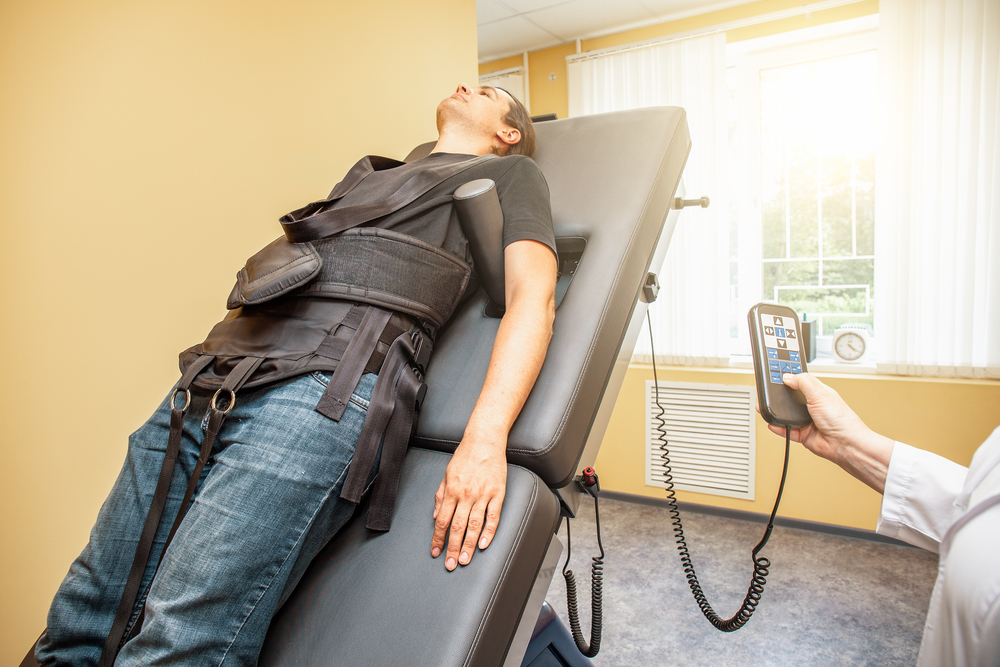
- Non-surgical: Motorized traction gently stretches the spine in cycles to reduce pressure on irritated nerves and boost circulation to the spine.
- Surgical: A surgeon physically removes tissue impinging on the compressed nerves, such as damaged disc material, spinal bone spurs, or part of the lamina.
- Can you do spinal decompression at home?
- Certain stretches, hanging from a bar, or using an inversion table may offer some of the benefits of spinal decompression from home.
What Does It Mean to Decompress the Lower Back?
To decompress the lower back means to reduce pressure on spinal nerves, discs, and other tissues using motorized traction or surgery. The goal of decompression treatments is to alleviate back pain, radiculopathy, numbness, tingling, weakness, and reduced mobility.
How Spinal Decompression Works: The Mechanism Explained
Spinal decompression works differently depending on which approach (surgical or non-surgical) is implemented.
During non-surgical spinal decompression, a healthcare provider (usually a chiropractor or physical therapist) secures you into a harness and positions you on a table. The provider then operates the table using a computer, implementing motorized traction to stretch the spine in different positions. This helps with back pain and related symptoms by:
- Reducing pressure on the irritated nerves
- Creating space for more blood (and the healing oxygen and nutrients it contains) to flow to the damaged spinal tissues
- Calming tense muscles
- Helping to improve mobility and posture
A 2024 Cureus study found that motorized traction and spinal decompression treatments combined with conventional treatments were more effective than conventional treatment alone.
| How Surgical Spinal Decompression Works By Procedure | |
| Procedure | How it Works |
| Laminotomy | Removes a portion of the lamina (the piece of bone covering the back of the spinal canal) to create more space in the spinal canal |
| Laminectomy | Removes most or all of the lamina to create more space in the spinal canal |
| Discectomy | Removes herniated disc material that’s impinging on nearby nerves |
| Microdiscectomy | Minimally invasive approach to discectomy |
| Foraminotomy | Enlarges the foramen (bony openings through which spinal nerve roots leave the spine) |
Benefits of Non-Surgical Spinal Decompression
Non-surgical spinal decompression can benefit people struggling with back discomfort from poor posture, desk jobs, and certain injuries and conditions. Here’s how:
- Pain reduction
A 2022 study published in the International Journal of Clinical Practice found that non-surgical spinal decompression effectively reduced pain from a lumbosacral herniated disc.
- Improved function
Another 2022 study published in BMC Musculoskeletal Disorders found that non-surgical spinal decompression effectively reduced pain and functional disability in people with chronic lumbar disc prolapse.
- Non-surgical and drug-free
Non-surgical spinal decompression techniques are free of medications and incisions, making them a natural strategy to promote pain relief and improved function.
When non-surgical spinal decompression fails to resolve persistent back pain and neurological symptoms, or when those symptoms become disruptive to daily life, physicians may suggest surgery to restore quality of life.
Causes of Lower Back Pain and Tension
Lower back pain, tension, and neurological symptoms (like numbness, tingling, and weakness) can be triggered by acute injuries, lifestyle factors, or spinal conditions.
Trauma and Acute Injuries
- Back sprains (torn or overstretched ligament)
- Back strains (tears in muscle or tendon tissue)
- Vertebral fractures
Poor Posture and Lifestyle Factors
- Sedentary lifestyle
- Slouched or hunched posture
- Poor lifting technique
- Being overweight or obese
- Weak abdominal muscles
- Ongoing stress
- Poor sleep quality
- Unsupportive footwear
Spinal Conditions
- Spinal stenosis, a condition involving a narrowed spinal canal
- Spondylolisthesis, a condition involving a vertebra that slips out of place
- Radiculopathy, a condition involving nerve root compression that can involve the spinal nerve roots
- Sciatica, a type of radiculopathy affecting the sciatic nerve
- Scoliosis and other skeletal irregularities
- Arthritis affecting the joints of the spine
Symptoms That Signal You Need Spinal Decompression
These symptoms can indicate that you may benefit from spinal decompression therapy:
- Persistent back pain
- Numbness
- Tingling or pins-and-needles sensation
- Weakness
- Sharp, burning pain that radiates from the lower back down the backs of the legs (sciatica)
- Back stiffness and tension
- Improved pain when you sit or bend forward
Should You Try At-Home Spinal Decompression?
For people with mild symptoms that don’t yet require professional care, or those who aren’t candidates for spinal decompression surgery, at-home spinal decompression might help. Methods include:
- Stretches and yoga poses
- Stretching with an exercise ball
- Hanging from a bar
- Using an inversion table
You might benefit from at-home spinal decompression if you’re struggling with persistent back pain and neurological symptoms. However, to prevent making the problem worse, talk to your doctor before trying at-home spinal decompression, and only attempt safe, trusted methods.
Who Shouldn’t Try At-Home Decompression: Contraindications
At-home spinal decompression may not be safe for everyone. If you have any of the following contraindications, you should talk to your doctor or avoid home decompression entirely:
- Pregnancy
- Failed back surgery
- Vertebral fractures
- Previous spinal fusion
- Spinal infection
- Spinal tumor
- Blood-thinning drugs
When in doubt, speak with a healthcare provider to learn if home decompression therapy is right for you.
How to Prepare: Warm-Up and Breathing Basics
A proper warm-up and mindful breathing during spinal decompression exercises can help maximize its therapeutic benefits and prevent injury.
Warm-Up Before Decompression
Before diving into decompression exercises, warm up for five to 10 minutes to get the blood pumping. This helps prepare your muscles, ligaments, and tendons, making them more flexible in preparation for deep stretching.
Breathing Correctly During Each Exercise
To support deep, effective stretching, breathe deeply throughout each spinal decompression exercise. Inhale through your nose and exhale through your mouth, aiming for slow abdominal breathing (inhales that fill your belly, not your chest). You can also try the 4-7-8 breathing method: inhale for four counts, hold your breath for seven counts, and exhale for eight counts.
How to Decompress Your Lower Back at Home: Exercises
These techniques and exercises can help you release lower back tension on your own from home. Prioritize safety and proper form, and if you experience worsened pain or neurological symptoms, stop immediately and contact your doctor for professional care.
Side-Lying Technique
- Start by lying on the side of your body, either on a couch or bed, with your knees bent and your heels stacked.
- Dip your shins down, off the couch or bed. This should provide a sensation of your pelvis dropping to one side and a lower back stretch. Hold the position for 20 to 30 seconds.
- Return your shins to the couch or bed. Take a 30-second break and repeat.
- Continue to repeat the stretch for 10 to 15 minutes, with 30 seconds between each repetition.
Overhead Stretch
- Stand with your feet shoulder-width apart.
- Extend your arms above your head and interlace your fingers.
- Straighten your elbows so that your palms are reaching toward the ceiling.
- Slowly bend to either side to stretch the sides of the back.
- Hold the stretch for 10 to 30 seconds and repeat as needed.
Bar Hanging
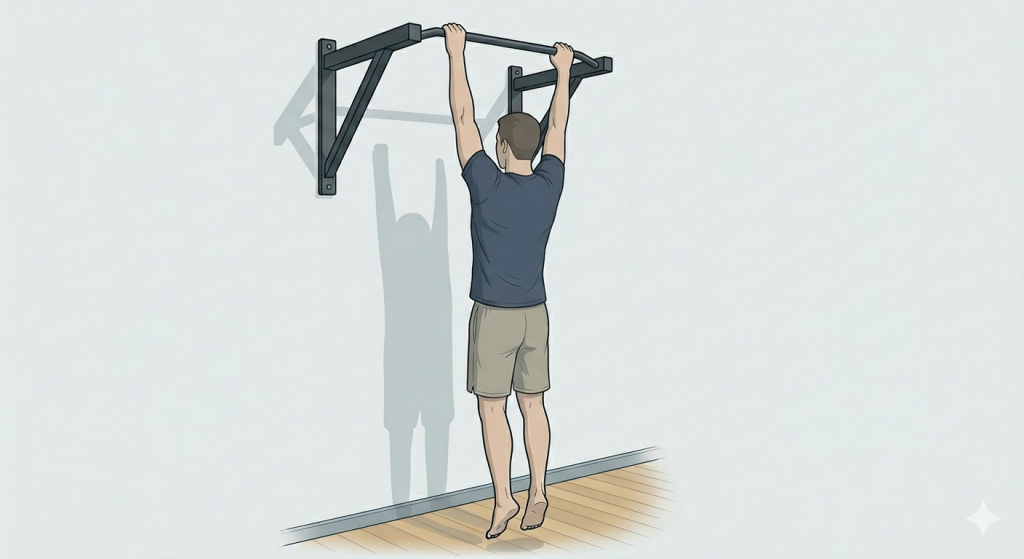
- Make sure your bar is sturdy enough to hold your full body weight (such as a pull-up bar).
- Grab the bar with both hands so that your feet lift off the floor.
- Hang from the bar, gradually relaxing your muscles so that your full weight is hanging from the bar.
- Remain in this position for 10 to 30 seconds, then release the bar so that your feet return to the floor.
- Relax for a minute, then repeat the exercise four to six times.
Pelvic Tilts
- Lie on your back with your knees bent and the soles of your feet flat on the ground. Your lower back should naturally lift slightly off the floor.
- On an exhale, press your lower back into the floor using your abdominal muscles and gently roll your hips upward, off the floor.
- Remain in a lifted bridge position for a few positions, then slowly return to the starting position.
- Repeat five to 10 times.
Cat-Cow Stretch
- Get on the floor on all fours, with your hips in line with your shoulders, your hands right under your shoulders, and your knees directly under your hips.
- Gently arch your back by moving your head down. Breathe deeply.
- Slowly move into a reverse arch by bringing your head and tailbone up toward the ceiling.
- Repeat five to 20 times.
Prayer Stretch
- Begin on the floor on all fours.
- Sit back on your knees so that your buttocks touch your feet. Drop your head and reach forward.
- Bring your weight forward onto your hands, stretching as far forward as you can without experiencing pain. Hold this stretch for 15 to 30 seconds.
- Repeat two to four times.
Child’s Pose
- Begin in a kneeling position on a mat or blanket.
- Slowly hinge forward, bringing your arms straight in front of you and your chest toward your knees. You can open your knees, keeping your toes together, and bring your chest toward the floor.
- Breathe deeply, remaining in this position for 30 seconds to several minutes.
Knee-to-Chest Stretch
- Lie on your back with your knees bent and your feet flat on the ground.
- On an inhale, draw one knee to your chest and hold for a slow breath.
- Repeat with the other leg, then repeat up to four times with each leg.
Downward Dog
- Begin on the floor on all fours.
- Press into your palms to lift your hips up and back, straightening your arms and legs.
- Breathe deeply and try to gently press your chest toward your thighs.
- Remain here for 30 seconds to one minute.
At-Desk Seated Spinal Decompression Exercises
According to the Bureau of Labor Statistics, the average civilian spends around 44.9% of their day sitting. Desk jobs place many of us at risk for back pain from prolonged pressure on the spinal discs and muscle tension, especially in the lower back and hip flexors.
You can perform the following seated decompression exercises from your desk to help prevent discomfort. Make sure to use a sturdy chair that can support movement.
Seated Press-Down
- Sit on the edge of your chair with your shoulders aligned over your hips.
- Place your hands on the armrests or the seat cushion beneath you and press down, releasing pressure from your back without lifting your buttocks off the seat.
Seated Spinal Twist
- Sit on the edge of your chair with your feet hip-width apart, flat on the ground.
- Inhale, and on an exhale, place your right hand on the back of the chair and your left hand on your right knee, gently twisting your torso to the right.
- Hold for a few deep breaths, return to the starting position, and repeat on the left side.
Seated Cat-Cow
- Sit with your back straight, away from the back of the chair, and your feet flat on the ground, hip-width apart.
- On an inhale, gently press your shoulders back and your belly forward, lifting your chest toward the ceiling with an upward gaze.
- On an exhale, draw your belly in to round your spine, thinking of your belly button reaching the back of the chair. Drop your chin to your chest and round your upper back.
- Repeat as needed.
How to Decompress the Lower Back and Hips Together
The lower back and hips are directly connected through the sacroiliac (SI) joint. But even beyond this anatomical connection, imbalances, tension, or injuries in the lower back can impact the hips, and vice versa. The piriformis stretch and figure-four stretch allow you to stretch both the lower back and hip muscles simultaneously to help keep discomfort at bay.
Supine Twist
- Lie flat on your back and hug both knees to your chest.
- Extend your arms out to either side, creating a “T” shape with your shoulders remaining flat on the ground.
- Inhale, and on an exhale, slowly release both knees to one side. Keep your knees stacked, look toward the opposite shoulder, and keep both shoulders on the ground.
- Remain in this position for a minute or two before repeating to the other side.
Figure-Four (Piriformis) Stretch
- Lie flat on your back with your knees bent and feet flat on the ground.
- Cross your right ankle over your left knee to create a figure-four shape.
- Gently pull your hamstring or shin toward your chest, without forcing it.
- Breathe deeply, holding this position for up to a minute before repeating on the other side.
Best Exercises for Sciatica Relief
Sciatica (defined by sharp, burning pain, numbness, and tingling that radiate from the lower back or hip into one or both legs) can often benefit from many of the exercises listed above. The best decompression exercises for sciatica, specifically, include:
- Piriformis stretch
- Cat-cow stretch
- Knee-to-chest stretch
- Child’s pose
Using an Exercise Ball to Decompress the Spine
You can use an exercise ball to gently decompress the spine from home or the gym. If you have an underlying spine condition, injury, or severe pain, talk to a healthcare provider before performing these exercises to ensure it’s safe for you. Performing the exercises improperly can place extra stress on the spine, and there is a risk of falling off the ball during the exercise.
- Face-up approach: Lie face-up with your back against the exercise ball. Once stable, slowly roll backward to stretch the spine.
- Face-down approach: Lie face-down with your belly on the ball, your arms out to the side, and the rest of your body relaxed around the ball. Try to release all of the tension in your arms and head, allowing your spine to gently release.
Spinal Decompression Exercises: Precautions and Contraindications
You shouldn’t attempt spinal decompression exercises on your own if you:
- Have been diagnosed with a spinal condition, like spinal stenosis or spondylolisthesis, and haven’t received clearance from your doctor to perform these exercises
- Have severe pain or disability
- Experience any warning signs while exercising, including:
- Sharp pain
- Pain worsening with movement
- Numbness or tingling
- Sudden leg weakness
- Bladder or bowel control problems
If you experience any of these red flags, stop exercising immediately and contact your doctor.
Sleeping Positions That Help Decompress the Lower Back
To sleep in a way that helps decompress your spine, or at least prevents further compression, opt for a chiropractor-recommended sleeping position. Sleeping on your stomach is never advised for spinal health, but you can choose either a side or back sleeping position.
Back Sleeping with Pillow Under Knees
Lie on your back and place a pillow under your knees, keeping them at a 30-degree angle. Place a pillow under your neck and maintain a neutral position of the head.
Sleeping on your back is widely considered to be the best position for spinal health. Using a pillow under the knees to relax your lower back can help decompress the spine while you sleep.
Side Sleeping with Pillow Between Knees
Lie on your side with your hips flexed around 30 degrees. Then, bend your knees to a 30-degree angle and flex your knees around 30 degrees. Place a pillow beneath your neck and a small pillow under your knees.
Inversion Tables: Benefits, Risks, and Safe Use
An inversion table is a device that allows you to safely hang upside down to decompress the spine and help with back pain. Hanging upside down uses gravity to release pressure on the spinal nerves and discs, allowing your back to relax. While you can purchase an inversion table for your home, they’re widely implemented by chiropractors, PTs, and spine specialists.
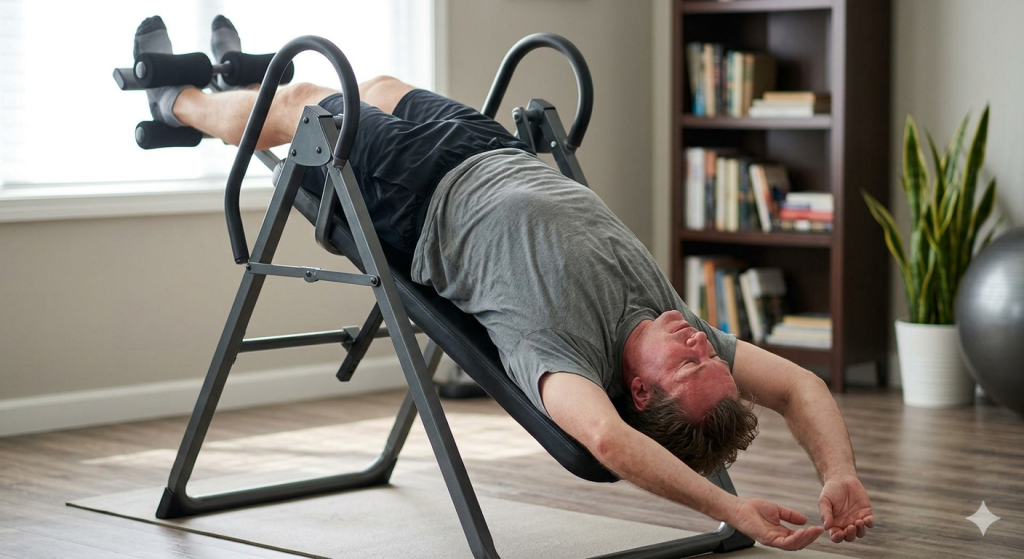
- Benefits: Inversion table therapy has been found to reduce symptoms and surgery rates in patients with sciatica and lumbar disc disease, according to a Journal of Physical Therapy Science study. It may also help improve mobility and promote muscle relaxation.
- Risks: Inversion therapy causes a high volume of blood to flow to your brain, which can lead to increased pressure in the skull. You should check with your doctor before trying it if you have:
- Heart disease
- High or low blood pressure
- Stroke
- An eye condition, like glaucoma
- Pregnancy
- Brain damage
- Acid reflux
- Tips for safe use:
- Talk to a healthcare provider first to ensure inversion therapy is safe for you.
- Try inversion therapy during a PT or chiropractor appointment before considering one for your home.
- Start with just 30 to 45 seconds upside down, and stop if you experience dizziness or worsened pain.
- Have a spotter nearby to provide help if needed.
How Often and How Long Should You Do These Exercises?
The ideal frequency for spinal decompression exercises depends on your symptoms, general health, and the specific exercises being performed.
- Gentle stretches can be performed daily, staying in each stretch for around 30 seconds to one minute while breathing deeply.
- Inversion table therapy can be performed around three times weekly for up to five minutes at a time.
How to Know If Spinal Decompression Is Working
Less back pain, numbness, tingling, and stiffness are the typical signs that spinal decompression treatments are working. It generally takes a few weeks of consistent sessions to yield noticeable improvements from non-surgical spinal decompression, while the healing process for surgical decompression can span three to 12 months.
Red Flags: When to Stop and See a Doctor Immediately
Stop spinal decompression therapy and contact your doctor right away if you experience new or worsened pain, tingling, weakness, or numbness, dizziness, or nausea. Additionally, these red flag symptoms merit a visit to the emergency room, as they can point to more serious nerve conditions:
- Loss of bladder or bowel control
- Saddle anesthesia (numbness in the inner thighs, buttocks, groin, and perineum)
- Sudden, severe, rapidly progressing numbness or weakness
At-Home Exercises vs. In-Clinic Spinal Decompression vs. Surgery: Which Is Right for You?
| Method | At-Home Exercises | In-Clinic, Non-Surgical Spinal Decompression | Spinal Decompression Surgery |
| Best for | Moderate, persistent lower back pain & tension. Symptoms that don’t improve with at-home care | Moderate, persistent lower back pain & tensionSymptoms that don’t improve with at-home care | Lower back pain & neurological symptoms that don’t improve after 6 to 12 months of conservative treatment |
What is L4-L5 Decompression Surgery?
L4-L5 decompression surgery is a form of spinal surgery that involves creating more space around compressed nerves at the L4-L5 level of the lumbar spine. This is most commonly achieved through a laminectomy, a form of decompression during which the surgeon removes some or all of the lamina to create more space in the spinal canal.
Is Lumbar Decompression Major Surgery?
Traditionally, lumbar decompression has been a major surgery involving a lengthy recovery period. This is because decompression is typically done with spinal fusion, a procedure that fuses the affected vertebrae to prevent spinal instability. Fusion involves placing bone graft material between the vertebrae to stimulate bone growth, permanently fusing the vertebrae over the next several months.
With recent innovations in spinal medicine, minimally invasive lumbar decompression methods are available, such as the TOPS System. TOPS is a mechanical implant device designed for use at a single level between L2 and L5 that replaces the tissues removed during decompression surgery. It restores a controlled range of motion in the spine, preventing fusion complications like reduced mobility and adjacent segment degeneration.
What Is the Recovery Time for Spinal Decompression Surgery?
The recovery time for spinal decompression surgery can last between one month and a year, depending on the method of decompression and the patient’s overall health. If spinal fusion is involved, the patient may need a full year to recover. With the TOPS System non-fusion implant, on the other hand, patients return to a natural range of motion immediately after the procedure.

David danced at his son’s wedding Bonnie explains why TOPS surgery was the right decision for her Wade is back to hiking Scott speaks about going to surgeryTake back control of your life with Premia Spine!


Regain your mobility with Premia Spine! Contact us now
Contact your healthcare provider to learn more about the right spinal decompression approach for your needs.
FAQs
- Is hanging from a bar good for your back?
- Hanging from a bar helps stretch and strengthen your back.
- What is the fastest way to decompress the lower back?
- Hanging from a bar, using an inversion table, or performing stretches like child’s pose
- Is spinal decompression safe during pregnancy?
- Inversion tables aren’t safe during pregnancy; gentle decompression stretches and prenatal chiropractic care are a safe alternative
- How long does it take for lower back decompression to work?
- Non-surgical lower back decompression typically starts working within a few weeks.
- Can I decompress my spine with a herniated disc?
- Yes, with guidance from a qualified healthcare provider
- What’s the difference between decompression and traction?
- Traction is a type of spinal decompression; not all decompression methods use traction.